Showing posts with label Latin. Show all posts

Sunday, April 18, 2010

Arma virumque cano

 
Just out of interest.
 
For those readers who did not have the good fortune (?) to study Latin at some point, the name of the blog you are reading right now is a direct reference to the opening line of the Aeneid - an epic poem by the Roman writer, Vergil. The poem tells the story of the Trojan hero, Aeneas, who is destined to become the ancestor of the Romans. According to legend he was one of the last men to escape the destruction of Troy - leading his wife and son out of the burning city while carrying his father on his back. He travels around the Mediterranean, including a pause in North Africa for a romantic interlude with the Carthaginian Queen Dido , before settling in Italy and defeating the local Latins. It's a good story filled with action and romance. But not too much. And the hero doesn't hesitate to abandon even a queen so that he may complete his mission - without considering the political ramifications.. (This leads to poor relations between the Carthaginians and the Romans for the rest of time.)

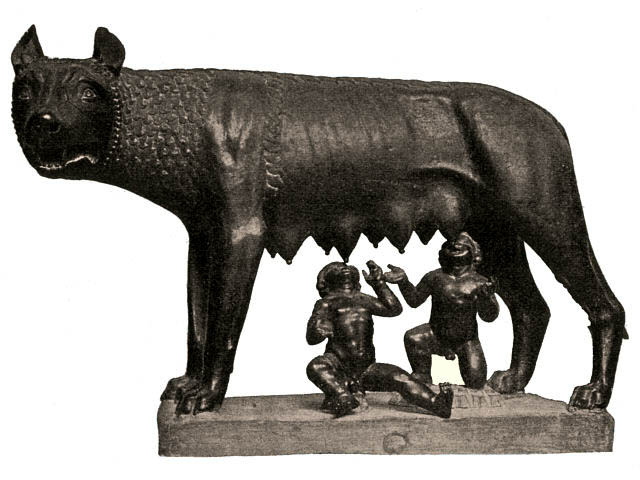
Anyway, Aeneas' direct descendant, Rhea Silvia, falls pregnant after an affair with Mars, the Roman god of war. (They meet in the forest...). Her sons are Romulus and Remus, who are raised in the forest by a she-wolf - with Romulus eventually founding Rome.
 
If you're interested there is more information here and here.
Monday, February 8, 2010

The Gladius

The military successes of the Roman legionaries stemmed from their intensive training and very strict discipline. And this weapon - the gladius.  


Which literally means sword. The word gladiator comes from this word as well as  Gladiolus - a flower with sharp, sword-shaped leaves.


The gladius was a short sword  that was used by Roman legionaries from the 3rd century BC and designed specifically for making short, powerful thrusts.


The weapon was about 60 cm (22 inches) long and generally weighed 3 pounds (1.4 kg) . In battle the Gladius was used in a thrusting action together with a large rectangular shield, the scutum.

This stabbing technique was most effective on the battlefield because its result was a deep stabbing wound to the midsection of an opponent. Unlike other swords that were used in strike to inflict glancing lacerations the thrust of a Gladius was almost always fatal.


On another continent, Shaka Zulu came to a similar realization about the deadly effect of stabbing in close quarter combat and virtually did away with the primary Zulu attack weapon of the time, the assegaai throwing spear, and introduced the iklwa .


The iklwa [was] a short stabbing spear, with a long, sword-like spearhead. It is said to have been named after the sounds made by its penetration into and withdrawal from the body.

The gladius and iklwa are separated by more than 1000 years, the Zulu weapon emerging later, but I have to wonder what would have happened if a Roman legion had met a Zulu impi in battle.

 My money would be on the boys from Rome.


"The race is not always to the swift, nor the battle to the strong, but that's the way to bet" Damon Runyan


Just found this. Nike Gladiator Sandals. For if you take your training really seriously, I guess.


Thursday, February 4, 2010

Latin Verbs

This might mean something to you if you struggled with Latin at some point in school or university...


What is a conjugation?
